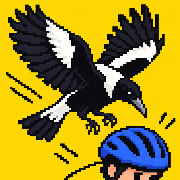
Your first ride
The bike moves along the street automatically. You steer freely across it, rather than snapping between lanes. Start by finding clear space, ducking the birds and looking beyond the next pickup. Wheelies and tricks are optional: you do not need either to keep riding.
- Make a small steering move. Learn how far the bike travels before trying to collect every shiny.
- Watch for the magpie warning. Duck as the bird attacks, then release after it passes.
- Save a little energy. Release boost and duck, then brake when you have a clear stretch.
- Choose one extra skill. Try a short wheelie or a ramp after steering feels comfortable.
The in-game welcome guide can be replayed from the menu. Practice Route gives you a repeatable course without changing your scored records or achievement progress. It is a place to learn, not a shortcut to a high score.
Keyboard and touch controls
On a computer
- A / D or Left / Right: steer across the street.
- W / S or Up / Down: boost or brake. During a wheelie, these inputs correct your balance instead.
- Hold Space: duck. Release it after the attack to let energy recover.
- Tap Q: hop a low obstacle. During a ramp jump, the same key attempts a trick.
- Hold E: lift into a wheelie. Release E to lower the front wheel and bank the points.
- P or Escape: pause.
On a phone or tablet
Turn your device sideways. In the browser game, touch anywhere in the safe left-hand control area, then push and hold left or right to keep steering. Small pushes make gentler corrections; holding to the side keeps the rider moving that way. Centre your thumb or lift to stop steering, then touch down again wherever comfortable. Push up to boost and down to brake. The Android app still uses its own floating-joystick tuning.
The right-hand buttons handle your actions: hold Duck, tap Hop, or hold the bike icon for a wheelie. While holding the bike button, use your left thumb’s up/down movement to balance. Release the bike button to bank. The pause button stays at the top.
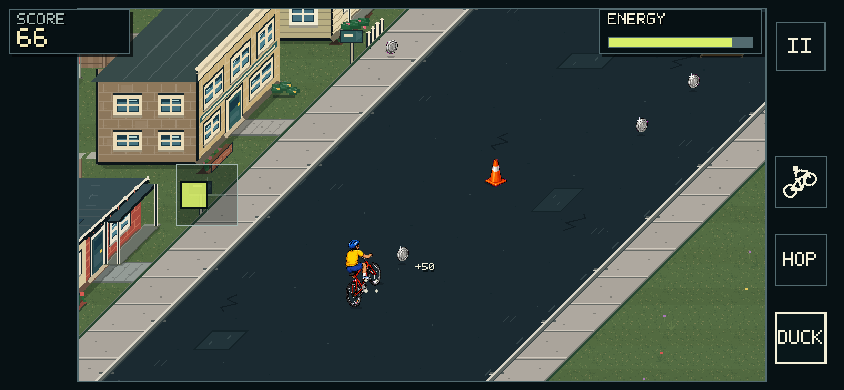
The left control area can be used higher or lower to suit your grip; the matching action buttons stay on the right. Browser players hold left or right to steer and lift to stop. Open the screenshot to inspect the full layout.
View screenshotKeep the road in view. Your thumbs belong in the side control areas. The mobile view keeps both pavements visible, but birds and moving objects still need your attention at the edges. Get help with mobile controls.
Energy is your emergency budget
Boosting, ducking, hopping, wheelies and tricks share one energy meter. Holding duck for the entire ride spends the resource you may need for the next attack. Boosting and ducking together drain it faster.
To recover, stop the actions that spend energy. Release boost and duck, lower your wheelie, then brake to recharge faster. Holding boost or duck with an empty meter prevents recovery. During a wheelie, the up/down controls balance the bike; pushing down is not a way to recharge while staying on one wheel.
- Bottles: top up energy and temporarily improve recovery.
- Helmets: provide a one-hit buffer. They do not make a collision a clean dodge.
- Shields: offer temporary protection. Watch for the expiry cue before taking another risk.
- Shinies: are score pickups, not energy refills.
Low energy does not remove steering or braking. When the meter is low, choose the gap instead of repeatedly trying a move you cannot afford. You can steer around low objects as well as hop them; a dog, bin or car needs a different line, not a hopeful jump.
A useful rhythm: spend energy on the threat, release the action when it is over, then use the next clear stretch to recover. Do not wait for an empty meter before thinking about the next bird.
Balance first. Bank before it goes wrong.
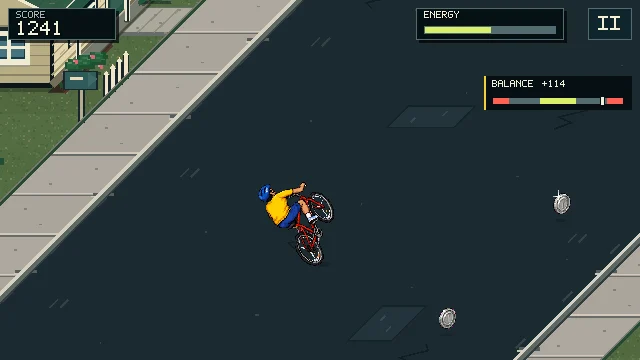
Watch the balance marker as the front wheel lifts. Release to lower it and bank your points before the wobble reaches an edge.
View screenshotHold E or the bike button on a clear stretch. Watch the balance marker and use small up/down corrections to bring it back towards the green centre. Long, hard corrections can send it past the centre and into a wobble on the other side.
The green zone uses less energy than the outer wobble zones, so a controlled wheelie lasts longer. Points build while you hold it, but they are not safely banked until you lower the wheel cleanly. Release before the marker reaches an edge, before energy runs out or before you need to deal with an obstacle.
A lifted front wheel is not hop protection. You still need to avoid ground hazards and respond to birds. Begin with short banks on clear road; add duration only when you can keep your eyes on the street as well as the balance meter.
Ramp tricks reward a precise press
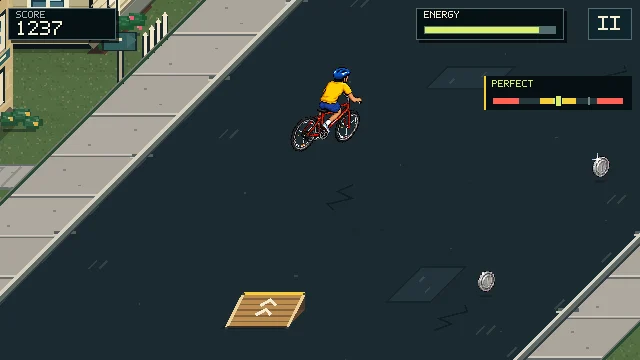
Watch the timing marker move towards the centre during the jump. The trick attempt is optional; a clean landing banks a successful attempt.
View screenshotRide onto a ramp and it launches you automatically. To attempt a trick, tap Q or Hop once during the flight. Watch the timing meter rather than repeatedly tapping: one funded attempt is judged for that jump.
- Perfect: hit the narrow green centre and land cleanly for 500 trick points.
- Close: hit the amber area beside it for a smaller 200-point bonus on landing.
- Miss: press farther from the centre, outside the red ends, and receive no trick bonus.
- Stack: attempt a trick in the first or last 20% of the flight and you crash on landing.
Simply passing through the red timing zones is harmless. It is the attempt in that zone that causes the stack. If you are unsure, do not press anything: you can land the jump without performing a trick.
The game varies the animation between five tricks: bike whip, tabletop, nose dip, bar turn and tuck jump. You do not need to learn five button combinations. The skill is deciding to attempt one and placing the press accurately. Use the early/late feedback after a missed attempt to adjust the next one.
Build a score, not just a long ride
Shinies, clean obstacle clears, bird dodges and successfully banked stunts give you reasons to take a more demanding line. Survival still matters: a risky pickup is not worth ending a ride you wanted to take further.
FLOW rewards quick, clean play
Qualifying scoring actions build FLOW and raise its score multiplier. Its normal window is three seconds: a quiet stretch without another qualifying action lets it expire. A clean wheelie bank of sufficient duration or a close/perfect ramp trick can keep an already-earned FLOW streak alive.
A registered hit breaks FLOW, even if a helmet absorbs it. Losing a streak does not take away points you already banked. An active streak can survive the opening swarm warning, so you are not required to manufacture a trick while the flock gathers.
Skill links need three different skills
A LINK combines three different confirmed skills, each less than three seconds after the previous one. Eligible actions are a clean obstacle hop, a precisely timed duck, a clean wheelie bank lasting at least 1.2 seconds, and a close or perfect ramp trick. Completing a link banks 150 bonus points.
Repeating one move does not extend the link timer. Hopping on empty road, making a tiny wheelie or landing without a trick will not fill it. Look for opportunities the street gives you rather than trying to force a combo through a blocked route.
Give the next ride a purpose
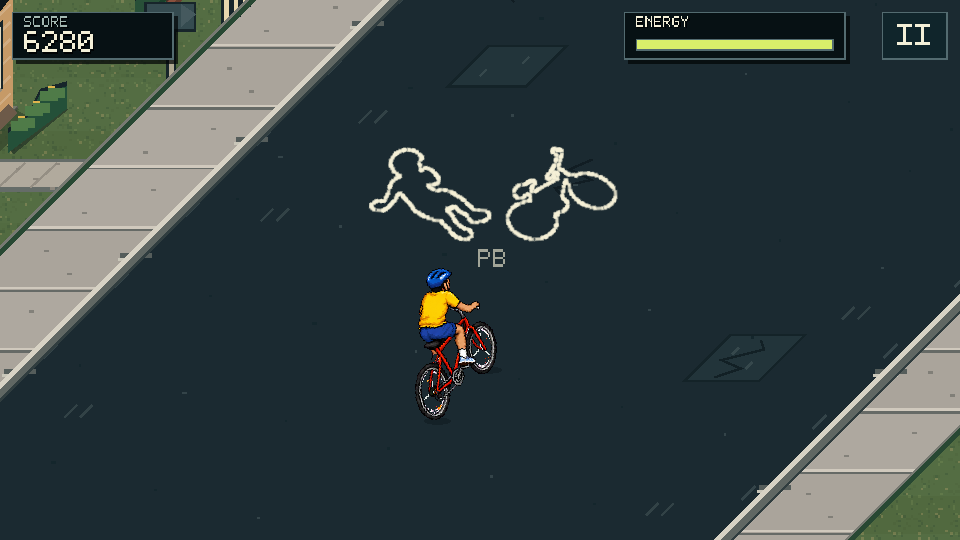
The chalk rider and bicycle show where your furthest ride ended. Ride straight past them: this is a distance marker, not an obstacle.
View screenshotYour best score and furthest distance are separate records. A stunt-heavy ride can improve one without improving the other. The chalk rider and bicycle mark where your previous furthest ride ended, so passing them gives you a visible target.
Open Challenges to inspect the trophy requirements and progress. Select a trophy to see what it needs; unfinished achievements can be tracked during a ride. Some accumulate across scored rides, while others ask for a result in one ride. The description tells you which.
Today’s Street is a date-seeded course with a finish, repeat attempts and its own medals. Its records are separate from your endless best. Practice and drills are for learning and do not advance scored records or achievements.
Progress is saved locally in your browser. Clearing this site’s data, switching browsers or using another device can leave you with a separate set of records. There is no account-based cloud save. Read the local-save guidance before clearing anything to troubleshoot.